More VA Sellers Are Letting Non-Veterans Assume Right Now
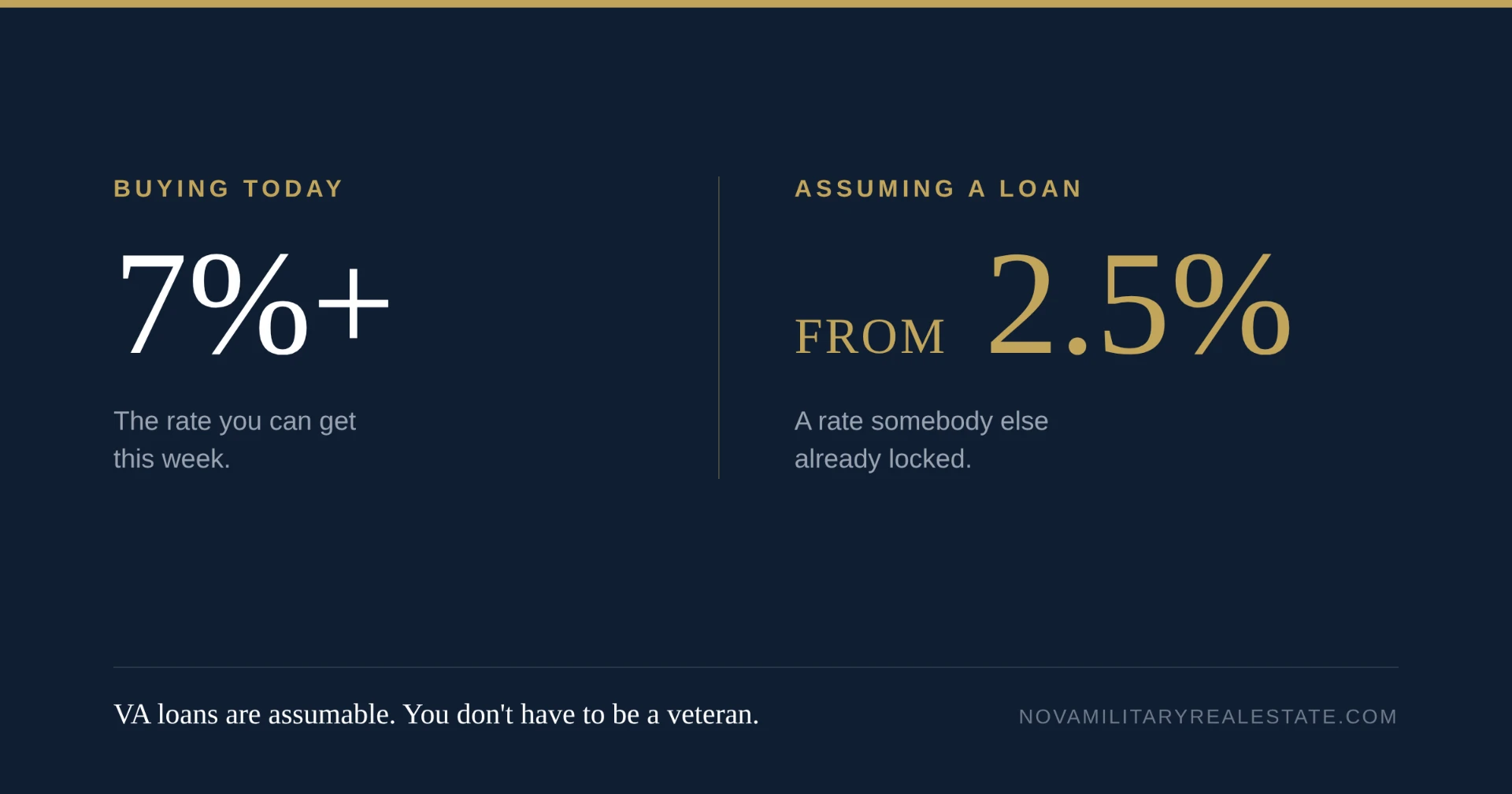
Rates are in the 7s. As the DC metro shifts toward buyers, more VA sellers are agreeing to let non-veterans assume, and the equity gaps right now are often smaller than a conventional down payment.
BLUF: Rates are in the 7s. Anyone who bought in the last three years is sitting on a loan in the 4s, 5s or 6s, and that loan is transferable. What changed this fall is that sellers are saying yes to assumptions they would have refused a year ago.
I track assumable inventory across DC, Virginia, Maryland and West Virginia, on the MLS and off it. Two things are happening at once right now and they are worth putting together.
The gaps are smaller than people expect
An assumption means taking over the seller's existing mortgage at their rate, their balance, and their remaining term. You are assuming the loan balance, not the purchase price, so you bring the difference.
That difference is what kills most of these deals, and in Northern Virginia it is usually enormous. I ran one in Manassas this month where the note balance was $420,000 against the asking price. The gap was around $275,000. That buyer walked, correctly.
But the gap is a function of how long ago they bought and how much the property appreciated since. On a property I looked at in Alexandria listed at $785,000, bought in 2022 with what looks like 100% financing, the balance works out to roughly $720,000. That is a gap in the sixties, depending on the exact rate and whether the funding fee was rolled in.
Sixty thousand dollars is less than a 10% down payment on that house. And you would be inheriting a rate from 2022 instead of buying one in 2026.
The pattern holds: the 2022 and 2023 purchases with high loan-to-value and flat appreciation since are where the gaps are reachable. The 2020 and 2021 purchases, where the property has run up 30%, are where the gaps are brutal.
Sellers are more willing than they were
Here is the part that actually changed.
If the buyer is not a veteran substituting their own entitlement, the seller's VA entitlement stays tied to that loan until it is paid off, refinanced, or restored. They do not lose it permanently, but it is locked up, and a seller who wants to buy their next home with a VA loan has a real problem with that.
For years that killed the conversation. Most veteran sellers said no.
What is different now is that this is turning into a buyer's market across a lot of DC metro zip codes. Showings are down, inventory is up, and listings are sitting. A seller who has cut price twice and is staring at ninety days on market weighs that entitlement question very differently than one who had three offers in a weekend.
I am seeing sellers agree to it. Not most of them, but enough that it is worth asking on any listing you like, and the question almost never gets asked.
Two situations where it costs the seller almost nothing, and where the answer is usually yes:
They do not need the entitlement. Paying cash for the next place, going conventional, moving in with family, relocating overseas. An estate sale. A divorce where one party is simply exiting.
They have plenty left. Remaining zero-down capacity is roughly the county limit minus the original loan amount. A seller with a $250,000 VA loan in Fairfax still has around a million dollars of room even with that entitlement tied up. They give up very little.
The part most people get wrong
You do not have to be a veteran to assume a VA loan.
That is the single most misunderstood fact in this market. You qualify with the servicer on credit, income, and debt-to-income like any other borrower. What being a veteran changes is that you can substitute your own entitlement, which releases the seller's and removes their objection entirely.
If you are VA-eligible, you have access to the full inventory. If you are not, you have access to a smaller slice, and it is worth knowing which slice before you start looking.
While everyone else waits
Most buyers are sitting this out. That is the whole reason there is room to negotiate.
An assumption is slower than a normal purchase, the servicer controls the timeline, and you need the cash or secondary financing to cover the gap. None of that is free. But a rate from 2022 is not available anywhere else at any price, and the people collecting them right now are the ones who did not wait for January.
I keep a running list of assumable homes across the region, including ones that are not marketed as assumable.