Available Now
No assumable listings at the moment. Get on the notification list and you can hear before they hit the MLS.
What Is a VA Loan Assumption?
Most mortgages are paid off when a home sells because of the loan's due-on-sale clause. VA loans are generally assumable, meaning a qualified buyer can take over the seller's existing mortgage — same balance, same rate, same remaining term.
If the seller locked 4.75% in 2021, you get 4.75%. Not today's rate. Theirs.
You do not need to be a veteran to assume a VA loan. That surprises most people, and it's the single most misunderstood fact about assumptions.
Why This Matters Right Now
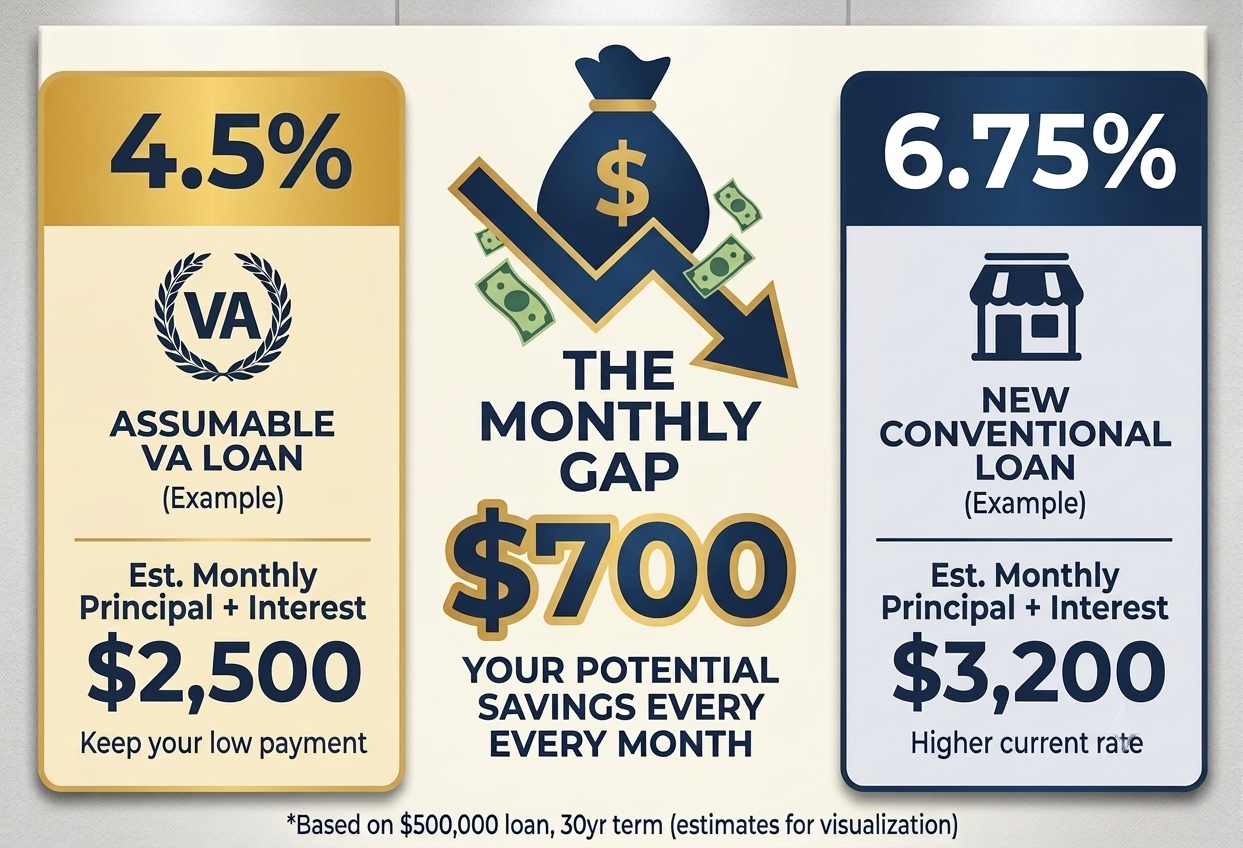
On a $500,000 loan balance:
| Assumed at 4.5% | New loan at 6.75% | |
|---|---|---|
| Principal & interest | $2,533 | $3,243 |
| Monthly difference | — | $710 |
| Difference over first 10 years | — | $85,200 |
That gap is why assumable homes can attract strong buyer interest, and why some buyers are willing to compete aggressively for the right opportunity. Run the numbers on the specific loan before you decide — balance and remaining term matter as much as the rate. If you're weighing this against renting on BAH, our BAH calculator can help you frame the monthly comparison.
The Part Most Listings Don't Mention
You have to cover the equity gap in cash.
You're assuming the loan balance, not the purchase price. If the home sells for $700,000 and the loan balance is $450,000, you bring $250,000 — cash, a second loan, or a combination. This is what kills most assumption deals in Northern Virginia, where equity positions are large.
It takes months, not weeks.
VA guidelines say 45 to 60 days. Reality is often longer. I worked an assumption where the servicer refused all electronic communication — every document between title and lender went by USPS, which significantly extended the timeline. That file took five months to close.
The servicer controls the timeline. The process is not always prioritized like a new loan origination, so timelines vary significantly by servicer. Some are professional about it. Some slow-walk it.
Seller entitlement is the piece nobody explains.
If the buyer is not a veteran substituting their own entitlement, the seller's VA entitlement stays tied to that loan — until the loan is paid off, refinanced, or entitlement is otherwise restored. A seller who plans to buy again with a VA loan needs to understand this before signing anything.
None of this means don't do it. It means go in knowing the timeline, the cash requirement, and the entitlement consequence. Deals fall apart when someone finds out in month three.
Your Rate Might Be Worth More Than Your Equity
If you locked a VA loan under current market rates and need to sell, that mortgage is transferable and it has value to a buyer. In some cases it supports a price above what comparable sales alone would justify, which matters if you're short on equity after selling costs.
It doesn't work for everyone. The buyer still has to cover the gap between your balance and the sale price, and your entitlement stays tied up unless a veteran substitutes theirs.
Who Can Assume a VA Loan
You can substitute your own entitlement, which releases the seller's. This is often the preferred scenario for sellers because their entitlement can typically be restored.
Fully allowed. You qualify on credit and income like any borrower, but the seller's entitlement stays attached to the loan.
You have to qualify with the servicer — credit, income, DTI. Assumption is not a way around underwriting.
Frequently Asked Questions
Get Notified When an Assumable Home Hits the Market
These listings are rare and they move fast. I track assumable VA inventory across Northern Virginia and Maryland and send it out before it's widely marketed. No spam. Just assumable homes that may actually be worth looking at.
Actively looking? When you sign up, reply to my first email with your target price, available cash, and preferred area. I can then point you toward opportunities that actually fit.