What That Crack in Your Basement Wall Is Actually Telling You
Not every foundation crack is a problem. But horizontal cracks, wall bowing, and stair-step mortar damage usually mean hydrostatic pressure — and that does not fix itself.
Not every foundation crack is a problem. Concrete shrinks as it cures, and thin vertical cracks in a poured wall are common in houses of every age and price point. But the direction of the crack matters more than the length, and one type deserves immediate attention.
Horizontal cracks are the ones to worry about
A horizontal crack running along a basement wall, often near the middle of the wall height or along a mortar joint in a block foundation, usually means the wall is being pushed inward. That force is hydrostatic pressure: water saturating the soil outside the foundation and pressing laterally against it.
Look for these alongside a horizontal crack:
- The wall bowing or leaning inward
- Stair-step cracking through mortar joints in block walls
- Doors sticking on the level above
- Efflorescence, the white chalky mineral deposit left behind by water moving through concrete
A vertical or diagonal crack often signals settlement. A horizontal one signals pressure, and pressure does not resolve on its own.
Why this shows up in our market
Northern Virginia sits on soils that make this worse. Fairfax, Loudoun, and Prince William counties are known for highly expansive clay, referred to locally as marine clay, rich in montmorillonite and smectite minerals. These clays absorb water and swell, then shrink and pull away as they dry.
The Woodbridge area is a good example. It sits in Prince William County near the Occoquan watershed and the Potomac shoreline, with heavy clay soils and drainage that struggles in lower-lying subdivisions. Homes built on slopes in that area frequently see basement walls bowing inward under saturated soil.
Maryland has its own version of the problem. Marlboro Clay, well documented in Prince George's, Charles, and southern Anne Arundel counties, is a notoriously unstable formation. Elsewhere in the state, including parts of Howard County, expansive clay shows up in pockets rather than uniformly, which is exactly why a soil condition on one street tells you very little about the street behind it.
Carbon fiber straps as a repair
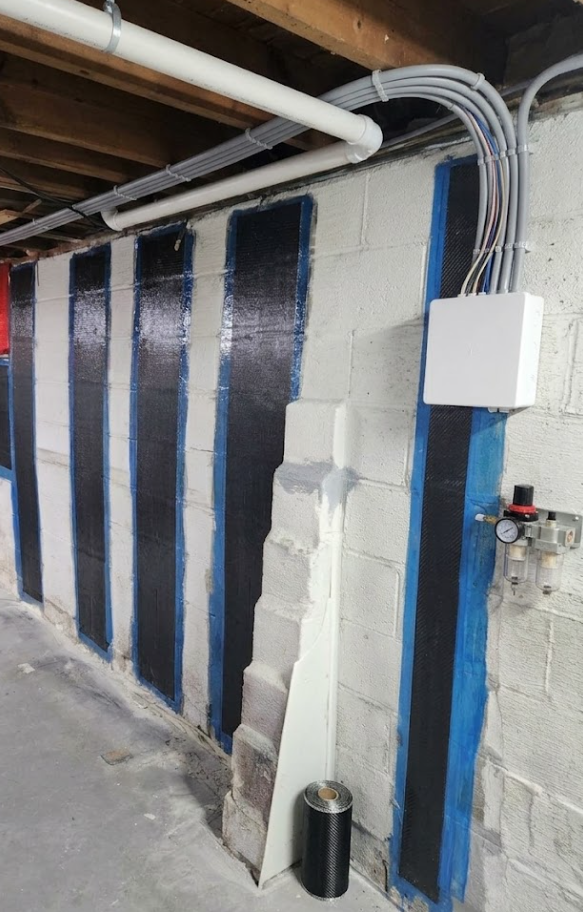
For a wall that is cracked and bowing but not badly displaced, carbon fiber straps are often the right fix. Strips of carbon fiber are epoxied vertically to the interior face of the wall, bonding to the concrete or block and resisting further inward movement.
What makes them attractive:
- No excavation of the yard
- Nothing protrudes into the finished space, so the wall can be painted or drywalled over
- Installation is typically a one-day job
- Tensile strength far exceeds steel by weight
The important limitation: carbon fiber reinforces a wall in place. It does not push it back. Industry guidance generally puts the practical threshold around two inches of deflection. Past that, or where the wall has shifted at the top or bottom, you are looking at steel I-beams, wall anchors, helical tiebacks, or in serious cases rebuilding the wall.
What actually fixes the cause
Reinforcement addresses the symptom. The water is the cause. Before or alongside any structural repair, deal with:
- Gutters and downspouts discharging well away from the foundation
- Grading that slopes away from the house
- Interior French drain and sump pump where groundwater is the driver
- Exterior waterproofing membrane if excavation is happening anyway
A reinforced wall with the same drainage problems will keep taking the same load.
If you are buying or selling
Buyers should treat a horizontal crack as a reason to bring in a structural engineer, not a general inspector, before the contingency expires. An engineer's letter costs a few hundred dollars and either resolves the concern or gives you a documented basis to renegotiate.
Sellers are usually better off addressing it before listing. A repair with an engineer's sign-off and a transferable warranty is a far easier conversation than an unexplained crack discovered on inspection day, which tends to cost more in credits than the repair would have.
Either way, get the engineer's opinion before the contractor's. Companies that sell the repair should not be the ones diagnosing whether you need it.
— Jon