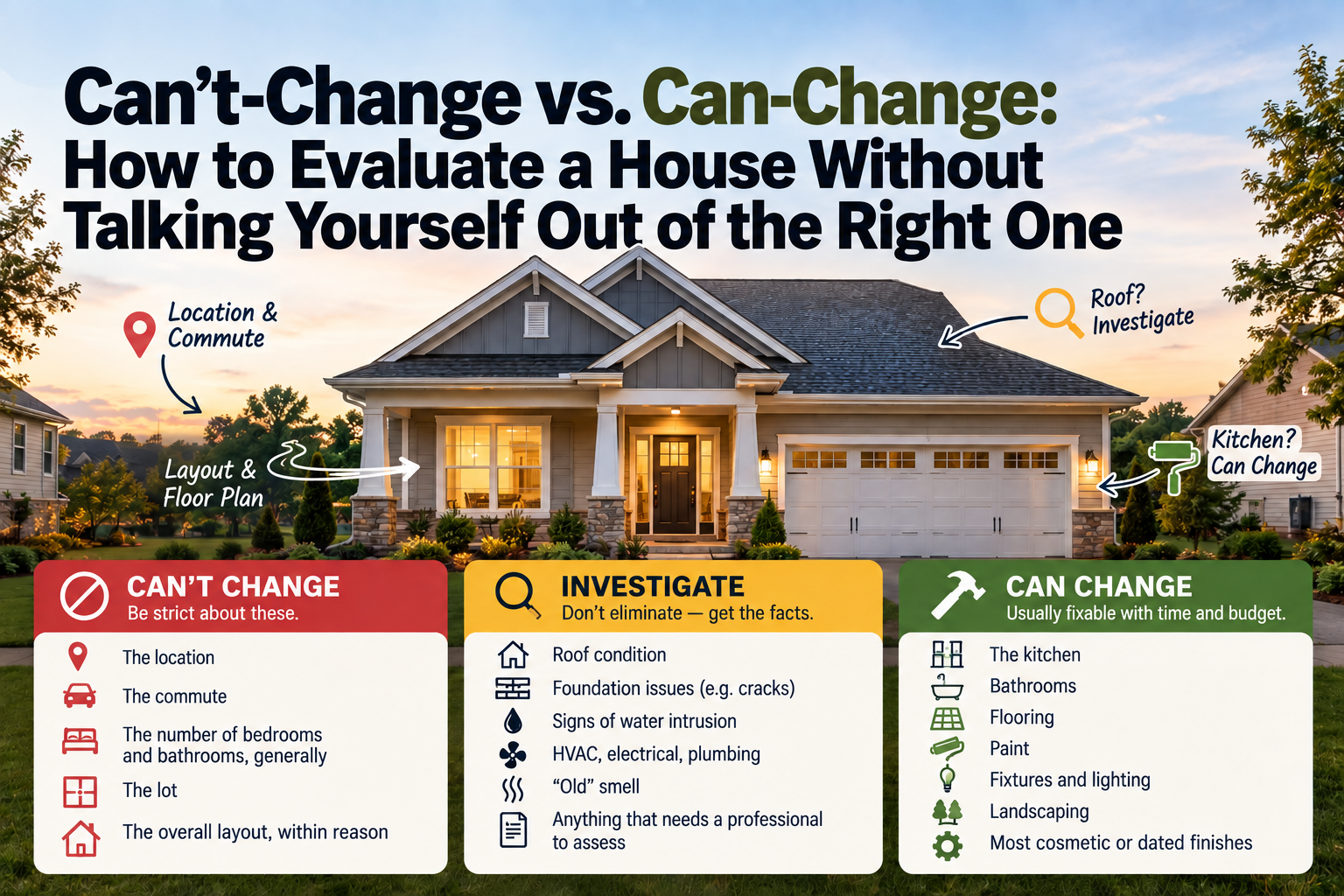
Can't-Change vs. Can-Change: How to Evaluate a House Without Talking Yourself Out of the Right One
After you've toured enough houses, the useful skill isn't finding the perfect one. It's separating what you can't change from what you can, so a fixable flaw doesn't cost you the right house.
After you've toured enough houses, the useful skill isn't finding the perfect one. It's separating the things you can't change from the things you can, so a fixable flaw doesn't cost you a house that's right on everything that matters. The only way to get every single thing you want in a house is to have infinite money, which most of us do not have.
No house is perfect. The more you tour, the more you notice, and the easy trap is killing a house over something that a coat of paint or a weekend of work would fix, while a house with the wrong location or the wrong layout gets a pass because it "showed nicely."
The fix is a simple mental operation. When something bothers you at a showing, ask which bucket it's in.
You can't change these
- The location
- The commute
- The number of bedrooms and bathrooms, generally
- The lot
- The overall layout, within reason
These are the things worth being strict about, because you're stuck with them. A great kitchen can't rescue a commute you'll hate every day for three years.
You can change or improve these
- The kitchen
- Bathrooms
- Flooring
- Paint
- Fixtures and lighting
- Landscaping
- Most cosmetic or dated finishes
Dated finishes feel like dealbreakers in the moment and almost never are. They're a budget and a timeline and often not a reason to walk.
The third bucket: investigate, don't eliminate
Some concerns aren't clearly "can't change" or "easy fix." For example, a crack in the basement wall or a roof that looks dated or an "old" smell. If the house is otherwise compelling, then these concerns should be investigated during the inspection and due diligence window, where the right professional can tell you whether it's a material problem and what it would actually cost to address. Investors buy houses that have fire damage, they do this because they know something many buyers do not – almost anything can be fixed. The mistake is eliminating a house on the spot over something that a professional could resolve. The move is to flag it and find out.
The point isn't to settle
None of this is about talking yourself into a house you don't like. It's the opposite. It's about not losing a house that's right on everything permanent because of something temporary and fixable, and not buying a house that's wrong on something you can never change because the staging was nice.
Sort what you're looking at into can't-change, can-change, and needs-investigating. Be strict on the first, relaxed on the second, and curious on the third. That's how you evaluate a house clearly instead of emotionally.