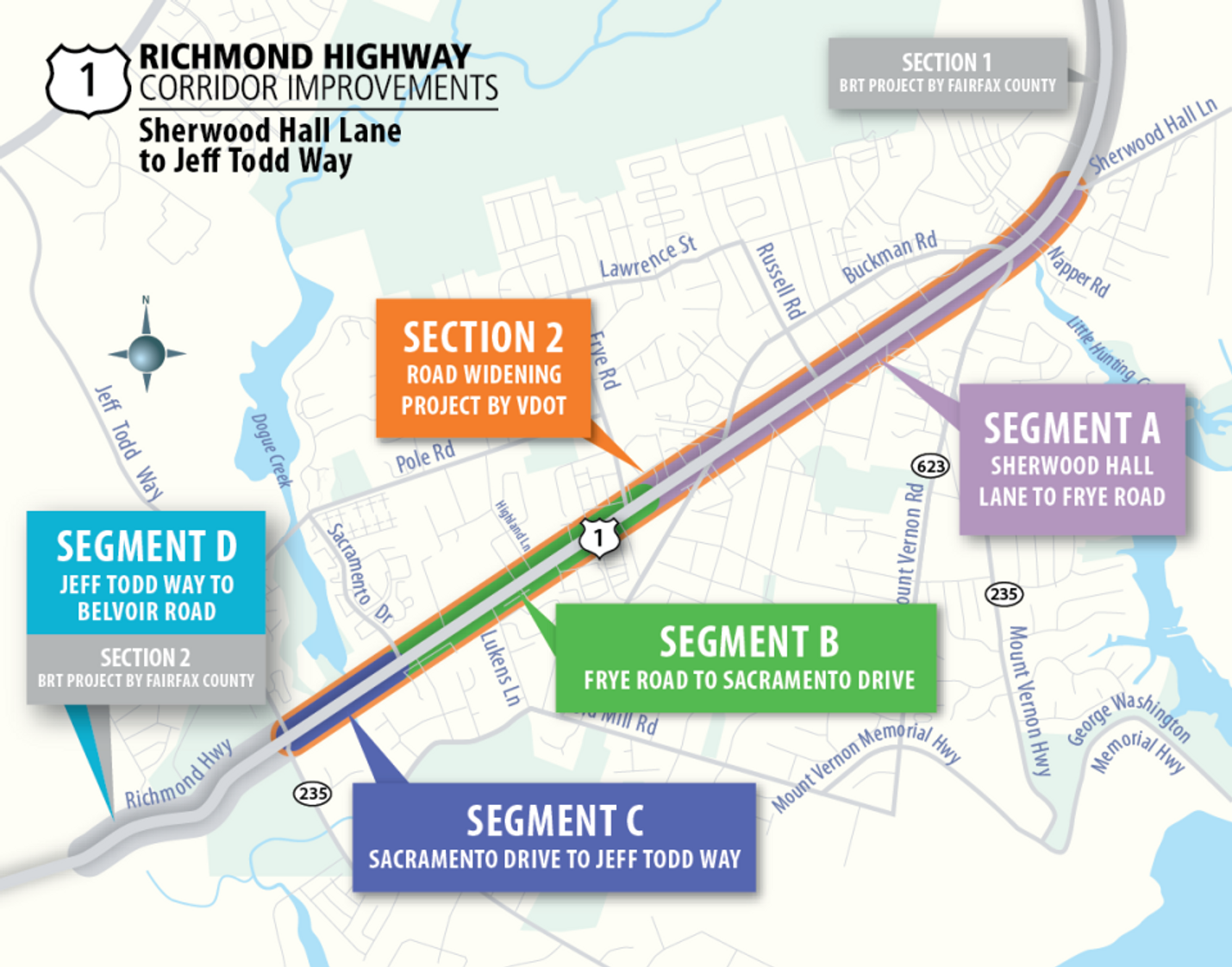
Richmond Highway Corridor Improvements segment map. Source: VDOT
The Route 1 Corridor: The Bad Road Is Being Rebuilt
Route 1 near Fort Belvoir has a reputation. But the corridor isn't just being patched — it's being rebuilt. Here's what buyers should know about the timeline, the tradeoffs, and the opportunity.
Anyone who has driven the Route 1 corridor near Fort Belvoir has probably heard the same comment:
"That's the bad road."
And honestly, that reaction makes sense. The corridor today has congestion, aging infrastructure, inconsistent pedestrian access, and sections that don't reflect the growth happening around one of Northern Virginia's largest military installations.
But there is another part of the story that many buyers overlook:
Route 1 is not just being repaired. It is being rebuilt.
Fairfax County's planned improvements represent a long-term transformation of the corridor, including roadway improvements, expanded sidewalks and bike infrastructure, space for future bus rapid transit, bridge replacements, and major intersection upgrades.
This is not a cosmetic project. It is the type of infrastructure investment that can change how a community functions — how people commute, how neighborhoods connect, and how attractive an area becomes over time.
I drove the corridor recently to show what it actually looks like today:
Why This Matters for Fort Belvoir Buyers
For military families relocating to the Fort Belvoir area, affordability is often one of the biggest challenges. Northern Virginia offers incredible access to jobs, amenities, and government installations, but home prices can vary dramatically from one neighborhood to the next.
The communities along the Route 1 corridor — including Huntington, Hybla Valley, and Woodlawn — currently offer something that is increasingly difficult to find close to major employment centers:
relative affordability with significant planned investment nearby.
Buyers may find older homes, larger lots, and lower price points compared with some surrounding Fairfax County neighborhoods — while also being positioned near one of the region's largest infrastructure improvement efforts.
That combination can be appealing for buyers who are thinking beyond the next few months and evaluating where an area could fit into their long-term plans.
The Timeline Is Longer Than Most People Realize
This is where buyers need to be realistic. VDOT's published schedule for the Richmond Highway Corridor Improvements shows just how long this process has been running — and how much is still ahead:
- First public information meeting: April 2017
- NEPA public hearing: October 2018
- Design public hearing: March 2019
- Right of way acquisitions beginning: April 2021
- Segment C utility relocations: April 2026
- Segment B utility relocations: Mid-2026
- Segment A utility relocations: Early 2027
- Segment C construction begins: Mid-2027
- Segment B construction begins: Mid-2028
- Segment A construction begins: Early 2029
Read that last line again. Construction on Segment A doesn't begin until 2029 — twelve years after the first public meeting. And these are planned dates. Large infrastructure projects routinely slip.
There is also a cost to being there during the work. Rebuilding several miles of a road means years of lane closures, detours, and construction traffic on the corridor you drive every day. If you buy along Route 1 now, you live through the construction before you benefit from the result.
The Tradeoff: Current Conditions vs. Future Potential
Of course, every buyer has different priorities.
If you are purchasing a home with a short timeline, the current condition of the corridor matters more. You may care more about what the commute looks like today than what improvements may come years from now.
But for buyers with a longer horizon, the question changes.
Instead of asking:
"Is Route 1 perfect today?"
the better question may be:
"Does buying in an area before major improvements are completed make sense for my timeline and goals?"
For some buyers, that tradeoff creates an opportunity. For others, it may not be the right fit.
The key is understanding what you are buying today — and what is planned for tomorrow.
Helping Buyers See the Whole Picture
Real estate decisions are rarely just about a house. They are about location, timing, infrastructure, commute, affordability, and future quality of life.
The Route 1 corridor is a good example. The road you see today may not be the same corridor you experience years from now.
For military families and Fort Belvoir buyers trying to balance budget, commute, and long-term value, understanding that context matters.
Wondering whether the Route 1 corridor fits your PCS timeline or home-buying goals? I'm happy to help you evaluate the tradeoffs.
Source: VDOT — Richmond Highway Corridor Improvements in Fairfax County
— Jon