I Built a Sell-or-Rent Calculator Because Nobody Could Answer the Question
Military sellers kept asking whether to sell or rent when orders dropped. Every calculator assumed equity and ignored VA loans. So I built one that doesn't.
BLUF: Military sellers kept asking me whether to sell or rent when orders dropped, and every calculator I could point them to assumed they had equity and ignored VA loans entirely. So I built one that doesn't. It's free, it's at PCSNumbers.com, and here's what it does.
The question I couldn't answer well enough
Orders drop. You have a house. You have about six weeks to decide whether to sell it or keep it as a rental.
I've had this conversation dozens of times. It's a numbers question, and the honest answer requires running numbers most people don't have in front of them — net proceeds after selling costs, realistic rental cash flow, principal paydown, and what keeping a VA loan does to your next purchase.
I was doing that by hand, one client at a time, in a spreadsheet. Fine for my clients. Useless for the service member at Fort Riley who doesn't know me and just wants to know whether they're about to make an expensive mistake.
So I looked for a tool to send people to.
What already existed
There are sell-or-rent calculators. Most of them make two assumptions that aren't true for military homeowners.
They assume you have equity. Enter your numbers and out comes "you'd net $87,000, invest it." If you bought with zero down two years ago, you might owe money at closing. Most calculators either break or return a nonsense negative number, and none of them tell you what to do about it.
They ignore VA loans. This is the bigger gap. If you keep the house, part of your VA entitlement stays tied to it, which changes what you can buy at your next duty station with nothing down. Every tool I found put that in a disclaimer — "talk to a VA-experienced lender" — and moved on. That's the single most PCS-specific variable in the decision and nobody was calculating it.
What the tool does
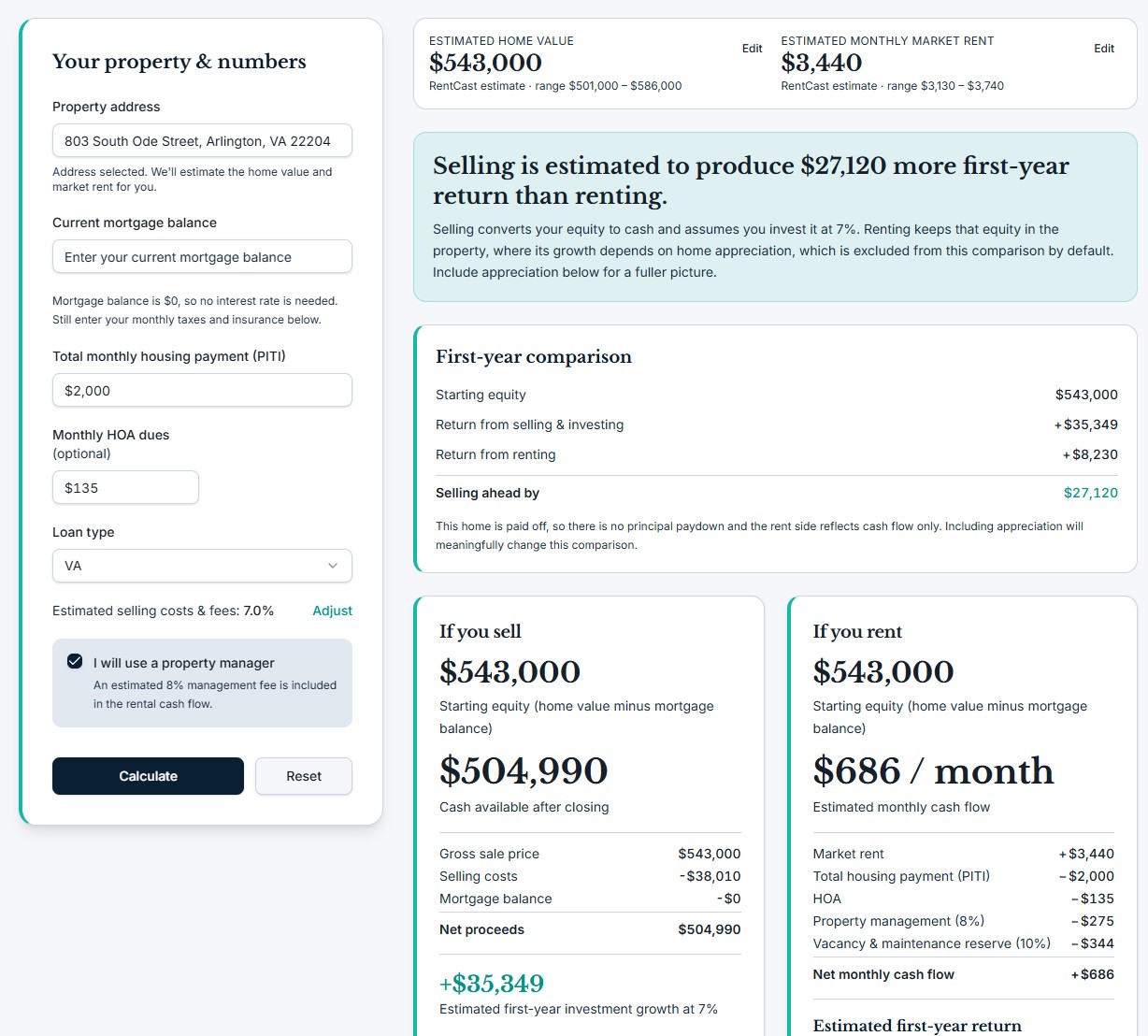
- Enter an address. It pulls a home value and market rent estimate automatically. You can override both. Most calculators make you hand-enter six figures you have to go look up first.
- It runs a real amortization. Not an estimate of principal paydown — an actual twelve-month schedule off your balance and rate. That number matters more than people expect, and it's usually the largest component of what renting produces.
- It calculates your VA entitlement position. Side by side: what you could buy with zero down at your next station if you keep this home, versus if you sell it. That's the piece nothing else does.
- It handles being underwater honestly. When selling requires bringing cash to the table, it says so plainly and stops pretending the two options are comparable.
- It separates cash from paper. Appreciation is a toggle, not a hidden assumption baked into a headline number. You can see what the decision looks like with and without it.
Here's it running on a real property
A Springfield townhouse near Fort Belvoir. Real market data, details anonymized.
| Estimated value | $550,000 |
| VA loan balance | $550,000 |
| Rate | 5.75% |
| PITI | $3,900/mo |
| HOA | $100/mo |
| Rent estimate | $3,020/mo |
What the tool returns:
Selling requires $38,500 at closing. Zero equity on paper is not break-even — 7% in selling costs on a half-million-dollar house is $38,500, and it has to come from somewhere.
Renting costs $1,524 a month out of pocket. Not the $880 gap you get comparing rent to the mortgage payment. Add HOA, a property manager you'll need from your next station, and a realistic vacancy reserve.
But the tenant pays down $7,075 of principal in year one, so the real annual cost of holding is about $11,200, not $18,300. With 3% appreciation it turns positive. Without it, ten years of holding runs about $60,000 in cumulative loss.
And the part that decides it for a lot of people: keeping this VA loan caps your next zero-down purchase at about $282,750. Selling and paying it off restores full entitlement, and there is no VA loan limit for full-entitlement borrowers.
In Northern Virginia, $283,000 doesn't buy much. If your next station is expensive, that constraint may make the decision for you.
What it can't do
It's a planning tool. It gives you a range in two minutes so you know whether you're in the territory where selling is even possible.
It is not a net sheet. It doesn't know your exact payoff with per-diem interest, your specific Virginia transfer and recordation taxes, your settlement fees, or your prorations. I've had clients think they were $5,000 short and find out they were $35,000 short.
It also can't price your house. The value estimate is an automated one, and automated valuations are frequently wrong in both directions. What your home actually sells for depends on condition, competition, and how it's brought to market.
So: use it to figure out which conversation you need to have. Then have the conversation.
Try it
PCSNumbers.com — free, no sign-up, results appear immediately. There's also a 2026 nationwide BAH calculator and written guides on VA entitlement and what to do when you're underwater.
Property details anonymized. Figures are estimates based on stated assumptions. Actual proceeds are confirmed by the settlement company at closing. VA entitlement figures are planning estimates — confirm with a VA-experienced lender.
— Jon