What You Actually Keep When You Sell
Your sale price isn't your take-home. Here's how loan payoff, commissions, taxes, title fees, and credits add up — and why two homes can sell for the same price but produce very different net proceeds.
Ask most homeowners what they'll walk away with when they sell, and the math sounds simple: sale price minus what's left on the mortgage. Whatever's left is the check.
It's almost never that clean.
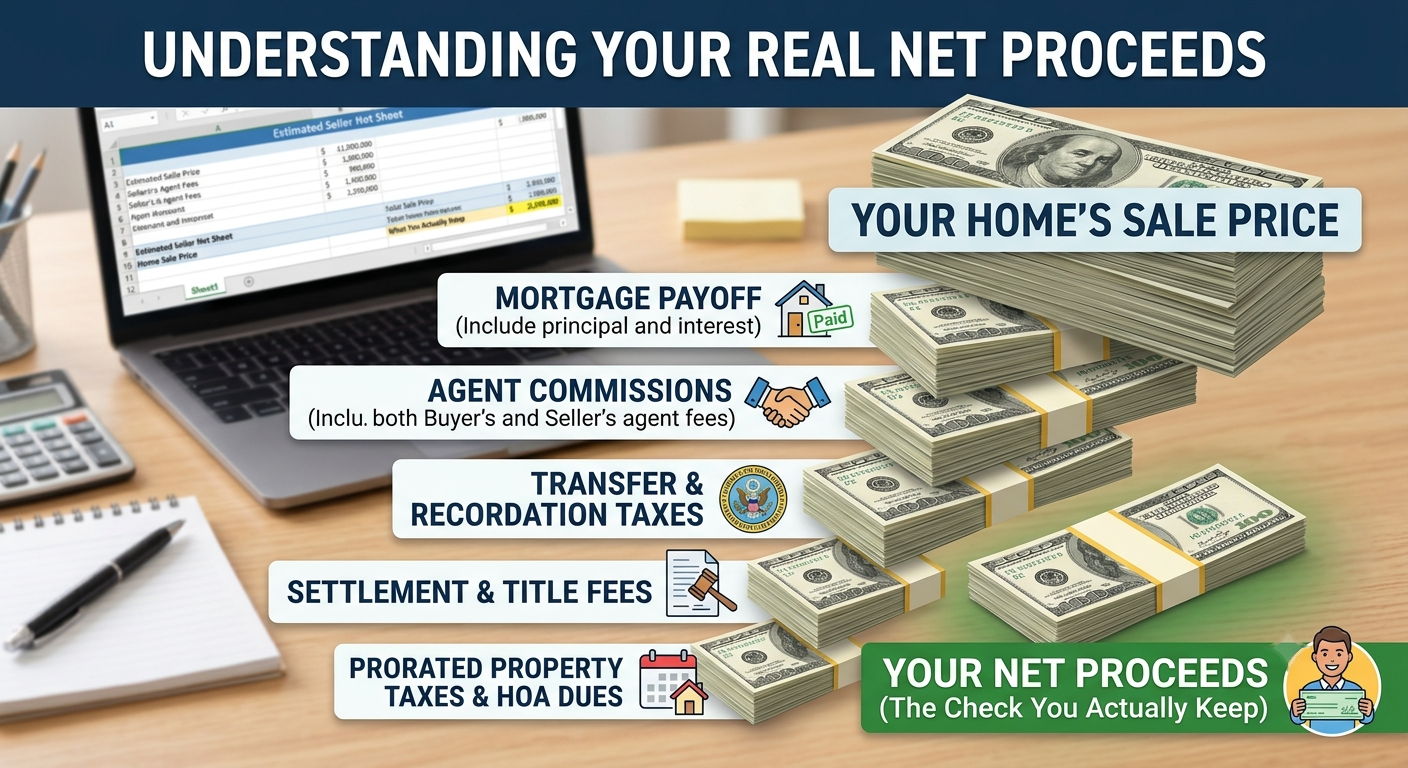
Between your sale price and the money that actually hits your account, there's a stack of costs that most online estimates ignore. Your loan payoff isn't just your principal balance, it includes interest through the closing date, and sometimes other items your lender attaches. On top of that come selling costs: commissions, transfer and recordation taxes, settlement and title fees, any credits you negotiate with the buyer, and prorated property taxes or HOA dues. Individually they seem small. Together they routinely add up to real money. A lot of sellers assume that skipping an agent means avoiding commissions entirely. In practice, most buyers come with their own agent, and that compensation gets negotiated into the deal — often coming out of the seller's proceeds either way.
Here's why it matters more than people expect. Two homes can sell for the exact same price and produce very different net proceeds, depending on the loan, the closing date, and how the costs fall. And for a homeowner with limited equity — common with newer purchases or low-down-payment loans — the gap between "sale price minus loan" and actual net can be the difference between walking away with a check and bringing money to closing.
That's not a reason to panic. It's a reason to run the real numbers before you list, not after you're under contract. When I work with a seller, I build an estimated net sheet up front — every cost line, at a few different price points — so the decision to sell is made with the real figure in view, not a rough guess that falls apart at the settlement table.
Want a rough preview before we talk? The PCS Home Decision Tool lets you plug in sale price, loan payoff, commissions, and closing costs to see what you'd actually keep — or whether selling may mean bringing cash to closing.
Your equity isn't your sale price minus your loan. It's what's left after the full picture. Know that number first, and every decision after it gets easier — including how you price the home, which often has more impact on your net proceeds than holding out for a higher list price.
Thinking about selling? I'll run your real net proceeds before you commit to anything.
— Jon